AHA vs. Red Cross vs. HSI: Which CPR Card Do You Need?
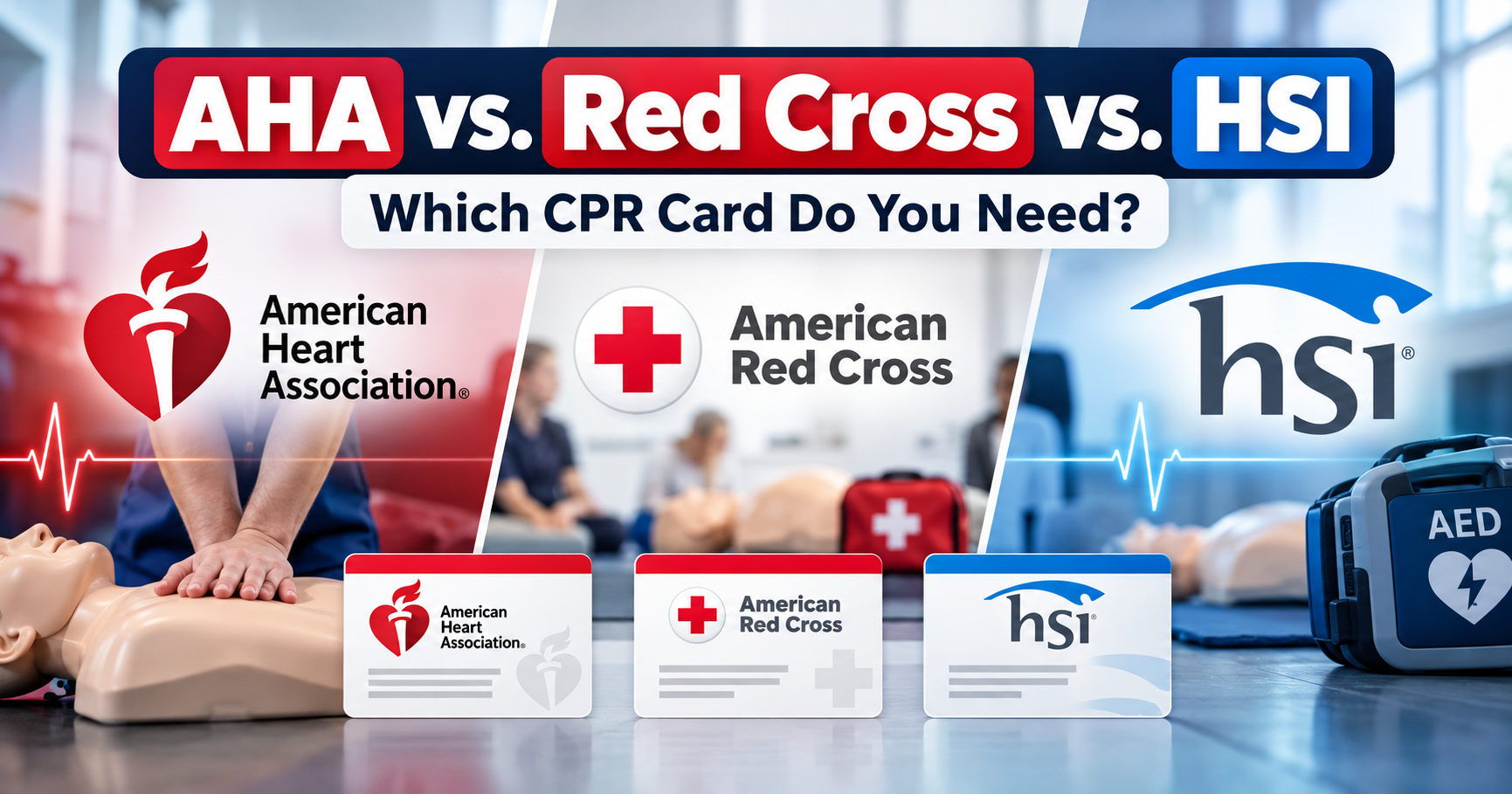
If you’ve started shopping for a CPR class, you’ve probably noticed three names over and over: the American Heart Association (AHA), the American Red Cross (ARC), and the Health & Safety Institute (HSI). They’re all legitimate and widely recognized. But they aren’t interchangeable for every job, and picking the wrong one can mean taking the class twice.
The short answer
- Working in healthcare, or studying for it? Choose AHA BLS unless your employer or program says otherwise. It is the most commonly required card in hospitals, clinics, and nursing programs.
- Need CPR for a workplace, school, daycare, or fitness job? AHA, Red Cross, and HSI are all commonly accepted. Check with your employer or licensing body.
- Not sure? Ask in writing which organization and course name they require.
American Heart Association (AHA)
The AHA sets the resuscitation science and guidelines that many other organizations follow. Its Basic Life Support (BLS) course is the standard in healthcare settings. Its Heartsaver courses cover CPR, AED, and First Aid for the general public and workplaces. If you’re a nurse, EMT, dental professional, or a student in a clinical program, this is typically the card you want.
American Red Cross (ARC)
The Red Cross is one of the best-known names in CPR and First Aid training. Its courses are common for workplaces, schools, camps, lifeguarding, and community groups. Red Cross also offers healthcare-provider-level training, though many hospitals specifically request AHA.
Health & Safety Institute (HSI)
HSI (which includes the brands MEDIC First Aid and ASHI) is widely accepted for workplace and community training, and is accepted by many employers and regulatory contexts. It’s a common choice for businesses that want practical, flexible training for employees.
Do the courses teach different things?
All three teach the core skills: recognizing an emergency, calling 911, performing high-quality chest compressions, giving rescue breaths, and using an AED. The differences are mostly in course structure, materials, branding, and the specific acceptance rules of the organizations that require them, not in whether you’ll know what to do in an emergency.
How to find out which card you need
- Ask your employer, school, or licensing board which organization they accept.
- Ask for the exact course name (for example, “BLS Provider” versus “American Red Cross CPR & AED”).
- Confirm whether a hands-on skills session is required.
- If they have no preference, choose the one that fits your schedule and learning style.
One provider, three options
At Chicago CPR Academy, you don’t have to guess. We offer AHA, Red Cross, and HSI certification, so we can match you with the right course. Tell us who is requiring your card, and we’ll confirm the best fit before you register. Call [phone] or request a class online.
Latest Blog Posts:
-
Boost Workplace Safety with On-Site CPR & AED Training by Chicago CPR Academy
February 19, 2024 -
AHA vs. Red Cross vs. HSI: Which CPR Card Do You Need?
October 27, 2026 -
CPR Class Near Me: How to Choose the Right Course in Chicago
October 27, 2026 -
Why Every Chicago Business Needs an AED in 2026–2027
October 14, 2026 -
CPR Classes in Northbrook and Chicago: Two Convenient Locations for CPR, AED, First Aid & BLS Certification
October 7, 2026 -
Hands-Only CPR: How You Could Save a Life Before Paramedics Arrive
July 13, 2026 -
On-Site BLS Training for Urgent Care Clinics in Buffalo Grove: CPR & AED Readiness
January 20, 2026 -
Why I Started Chicago CPR Academy — And the Moment That Changed Everything
April 3, 2026 -
Heat Stroke vs. Heat Exhaustion: How to Stay Safe in Chicago’s Extreme Heat
June 25, 2025 -
At-Home CPR Classes: A Life-Saving Skill Every Family Should Have
March 21, 2026 -
Hilton Chicago/Magnificent Mile Hotel On-Site Workplace CPR & AED Training
March 10, 2024 -
Why Every Minute Matters: Why Chicago Residents Should Know CPR Before EMS Arrives
July 18, 2026 -
The Importance of CPR: Understanding the Life-Saving Benefits of Cardiopulmonary Resuscitation.
November 18, 2023 -
Commotio Cordis; How it can happen to healthy athletes like Damar Hamlin
November 17, 2023 -
The Vital Importance of Comprehensive CPR, AED, and First Aid Training in Child Care Facilities: Meeting DCFS Standards
November 9, 2023 -
Heart Attack V.S Cardiac Arrest
November 17, 2023 -
The Tragic Consequences of Neglecting In-Flight Medical Equipment: A Wake-Up Call for Airlines
March 29, 2023 -
Ensuring Safety: Why Chicago Schools Must Prioritize CPR & AED Training for Staff
July 29, 2023 -
The Convenience of Blended Learning: CPR, AED & First Aid Classes at Chicago CPR Academy
October 15, 2023